

Welcome to Mark's Kitchen Diary
Where my cooking-story began, and what this newsletter's about.


Welcome to my Kitchen Diary.
I’m Mark Leach (above left), a British home cook and writer in San Francisco, California, where I live with my French husband Fabien (above right).
I’ve been a home cook since the age of 14.
Mum had asked my older brother and I to make a Chili con Carne. In the late 80s, spice mixes were all the rage. And Mum insisted we use it, so we did. But we both felt the urge to ditch the mix and experiment. While the extra chili didn’t go down well (literally and metaphorically), that experiment sparked a passion for food that’s been with me ever since.
It tagged along during my University year-abroad in Hungary. Then joined me when I moved to London, Paris and Berlin. And it’s still here, as I write this post in San Francisco.
Writing has also been a constant in my life. But since my teenage years, I’ve been reluctant to share my true voice. Instead, I’ve tried to second guess what people wanted to read (or hear). Of course, unless you have psychic powers (or work at Google), it’s impossible to know what others truly think. Cue a spiral of procrastination and fear that’s kept me from publishing my thoughts.
Until now.
What changed? Well, I’ve spent the past 3 years disclosing, dissecting, and distilling 50 years of mind gunk to a complete stranger. Someone who didn’t know me before, but now knows me more than anyone else. Which is no judgment on those who know me! I’m just exceptionally good at being whoever people want me to be. If only I liked Martinis, I could have been a spy…
The novelist Cathy Rentzenbrink says “writing is like anxiety medication you need to take daily”. I completely agree. It’s one of the reasons for launching this Substack. Writing, and publishing, will, I hope, help me be more authentic.
And I hope my posts will be as useful for you, as they will be for me.
But what will they be about?
What are they for?
Well, my goal is to:
Help you decide what to cook.
Sharpen your cookery skills.
I’ll do this by sharing my weekly menu, the inspiration behind it, a step-by-step recipe for one of those meals, and a cookery tip I’ve picked up over the past 36 years.
Here’s what that will look like in practice.
Each post will start with This Week’s Kitchen Menu.
This is where I’ll talk about our menu for the week ahead. And what inspired it.
To plan our meals, I ask questions like:
How are we feeling after the week? What do we need?
What’s the weather like?
Do we want to have friends over?
What’s in season?
But I also draw from other sources.
Movies we’ve watched, music we’re listening to, trips we’re planning or have taken, a cookbook or novel I’ve read, or a new kitchen tool I bought. To name but a few.
After that, in This Week’s Recipe, you’ll find detailed instructions on how to make one of these meals, complete with instructions and photos.
And finally, in the Weekly Tips section, I’ll share what I learned from cooking that, or other recipes, so you can learn from my “mistakes”.
Before I forget, a word on travel.
We visit Europe at least once a year (yes Mum, I know…). And while we try to find Airbnbs with half-decent kitchens (or gently requisition those belonging to friends and family), there will be weeks when I can’t cook. So when I’m kitchen-less, these posts will have more of a travel angle. They’ll still focus on food. But it’ll be what we’re eating in restaurants and bakeries, or what I’ve found in local markets and stores.
Oh, and I would love these posts to start conversations.
Between me and you. Between you and your fellow readers. Between you and whoever you like. Including yourself, I won’t judge. So please add comments, ask questions, and use this as your own kitchen diary.
And finally, these posts will be free of charge for now. To get them, scroll to the bottom of this post, enter your email, and new posts will be sent to your inbox every other Friday. Or for those new to Substack (Mum and Dad, Eliane et Jean Marc), you’ll also find them in the Substack app.
While I’ve rambled on, your first Kitchen Diary post has been patiently waiting below. You’ll find it after the share button below.
I hope you enjoy it. I’m excited to see where this journey takes us!
Mark
This Week’s Kitchen Menu
This week’s menu is mainly vegetarian.
We’ve been eating like this for about a year. Not just because it’s healthier, or better for the environment. But also tasty organic meat isn’t cheap in San Francisco.
There are just four meals here.
That’s partly because we’re off to a wedding this weekend. So I get two nights off. Yay! But also because I like to cook enough to eat one night, and save the rest for next day’s lunch or evening meal. Often doubling the recipe and popping half the meal in the freezer. There’s nothing better than frozen leftovers when I’m not in the mood to cook.
In fact, my dream kitchen would have twice our current freezer space. Oh, and be designed by our latest obsession, DeVol Kitchens. If you haven’t binge-watched their TV show yet, check it out.
So here’s what we’re eating this week:
Sweet and sticky Brussels sprouts with black rice
Impanata (pie) with a chard, dandelion and kale filling (for lunches)
Zucchini and white bean curry
Roast spatchcock chicken with lemons, potatoes and fennel (recipe below)
This Week’s Recipe
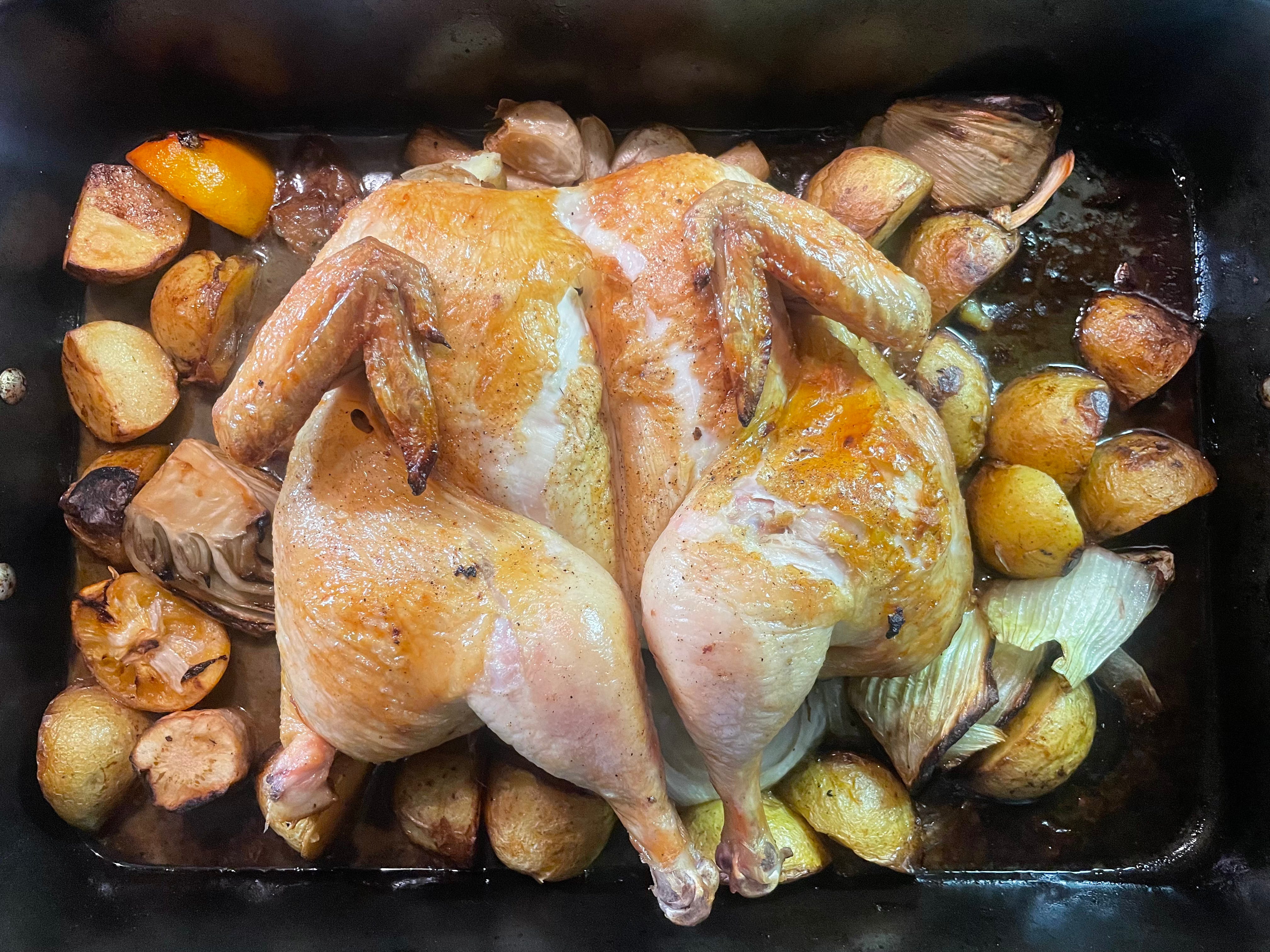
Roast spatchcock chicken, with Meyer lemon, potatoes and fennel
This is a variation of a dish in one of my latest cookbooks: The Farm Table, by Julius Roberts.
You’ll need a large (3 inches deep or more) roasting pan.
“Spatchcocked” means the chicken has been flattened out (see photo). This helps it cook quicker. You could also use a regular chicken, just cook it for about another 20 minutes.
Serves 4-6
Ingredients
1 organic chicken (mine was 5.5 pounds/2.5kg)
1 ¾ pounds/800g new potatoes, or large potatoes
2 fennel bulbs1 (or replace with 2 onions)
1 whole head of garlic
Olive oil
1 Meyer lemon (or replace with a regular lemon or even an orange)
Salt and pepper
1 large glass of white wine, Vermouth or water
Method
Remove the chicken from the fridge, and take it out of its packaging. If it hasn’t been spatchcocked, and you want to try yourself, here’s what to do. Place the chicken on a chopping board, breast side down. Run a sharp knife through the chicken, from top (neck) to bottom (the actual bottom?). Push both sides of the chicken down to flatten it out (see photo above).
Salt the chicken by sprinkling the side facing you with a teaspoon of salt and patting it into the skin. Turn it over and do the same on the other side. Leave it to sit for one hour. This brings the chicken up to room temperature, reducing the cooking time. It also allows the salt to penetrate the meat, making it tastier.
While you wait for the chicken, prepare the vegetables. And preheat your oven to 500℉/260℃.
Wash the potatoes to remove any dirt. You don’t need to peel new potatoes. I can rarely be bothered to peel large ones either. If you do, the juices will penetrate the potatoes, and they’ll taste better. You decide how much energy you have to wield that peeler.
Cut the fennel into quarters, lengthwise from top to bottom. This keeps the layers attached to the root, so the fennel stays together and won’t burn when roasted.
Wash the lemon to remove any wax (or buy unwaxed if possible), then cut into quarters.
Take the garlic bulb and press down on it with a knife. This releases the individual cloves. Then gently press down on each clove to slightly loosen it from its skin. This stops them burning, but helps the juicy garlic goodness ooze out while cooking.
Place the vegetables and lemon in the roasting pan. Ideally in one layer, so they roast rather than steam. Make sure the garlic is in the middle, where it’ll be covered by the chicken. This just makes (extra) sure you don’t get burnt, bitter cloves. Season with salt and pepper.
Put the chicken on top of the vegetables, drizzle over some olive oil.
Pop the pan in the oven and cook for 20-30 minutes, or until it starts to brown on top. Then turn the oven down to 325℉/160℃, open the door and pour a glass of wine into the pan. Cook for another 20 minutes.
Remove the pan from the oven and pierce the chicken leg with a skewer (or the tip of a sharp knife). If the juices are clear, it’s cooked. If they’re reddish, put it back in the oven for 5 more minutes, and test again. Repeat until the juices are clear. When cooked, lift the chicken out and onto a carving board, or serving platter. Anything that can capture the juices that seep out of the chicken. Cover with a large piece of kitchen foil. Put the pan back in the oven.
After another 5-15 minutes, remove the pan and check the vegetables are done using a skewer or knife. If not, pop back for 5 minutes.
Once the vegetables are cooked2, pour any juices that came off the chicken back into the pan. If there’s not enough liquid to give each person a couple spoonfuls of juice, add a small glass of boiling water, and gently shake the pan to combine the liquids. Place the chicken back on top, and serve.
Sides: The vegetables are usually enough for 4 people. But I often serve it with some blanched, then quickly sauteed greens. Or a green salad with vinaigrette.
I hate waste, so this time I used a slightly wizened fennel bulb that had been lurking at the back of the fridge. Oh, and instead of the second fennel bulb, I used a large onion, halved, then cut into 6 thick slices.
After roasting, the fenne’s root end and outer layer were chewy and bitter. Next time I’d remove the outer layer (or remember to use the fennel in its prime). I’d also cook the fennel underneath the chicken to soak up more of the juices and stay moist.