

English scones
A classic English teatime treat, Gary Oldman, and differences between American and British English.
Do I need an English dialect coach?
In a recent interview, Gary Oldman mentioned he’d hired one to relearn his British accent for the series, Slow Horses, after his native accent had been corrupted changed after years spent in California.
While I have no plans to star in a blockbuster TV show, listening to Gary talk, I noticed subtle changes to his accent that I’ve spotted in mine. After a bit of research, it turns out these differences are the most common ones between the English spoken in the UK, and that spoken over here. Both relate to the pronunciation (or not) of two letters: “t” and “r.
Quick linguistics lesson…
If you pronounce the “t” when you say “water”, you’re performing “glottalization”, which might sound like a medieval method of execution, but is actually the official name for a vocal technique that’s common in the UK, and some parts of the USA (New York and Boston, to be precise).
And if you pronounce the “r” when it appears in the middle of a word – “hard” for example – you’re engaged in a somewhat saucy-sounding act of “rhoticism”.
I've noticed my English accent slipping – so much so that I actually pronounce my t’s and r’s – because otherwise, I struggle to make myself understood in some very common situations.
Like ordering a coffee, for example.
When I order at the counter and they ask for my name to call out when my coffee’s ready, I face a dilemma. If I say “Mark” the way I would back home – “Mahk” – it usually draws blank stares. So now, I make myself say “Maarrrrrk,” which tends to work, but feels like I’m twisting my mouth into shapes no Englishman has attempted on American soil since the late 1600s.
Back then, a newly arrived Puritan settler called Mark would have had no trouble ordering his coffee in Ye Olde Coffee Taverne1, because English speakers still pronounced their "r’s."
This changed in the 18th and 19th centuries, when people began imitating the upper classes of London and the southeast, adopting what became known as received pronunciation, also known as the Queen’s English or BBC English. This made it harder for others to place you in the social hierarchy by stripping away regional markers, and making you sound like someone from an allegedly superior class.
But it’s not just my “r’s” that are being pronounced. I have similar issues with the letter “t”, which has become a “dd”, as in “tomaddoes, tomaddo sauce, and tomaddo ketchup”.
While my accent has changed, my firm belief in the true meaning of certain foods has not, “biscuit” being a prime example.
In the US, biscuits are a soft, flaky, and buttery bread-roll type affair. This is what Brits call a scone2, and you'll find a recipe for them below. For us, biscuits are lighter, and sweeter, but they’re not cookies, which are soft and have a chewy center. It’s complicated, and goes to show that the UK and USA really are two nations divided by a common language.
I hope you enjoy these scones, preferably covered in budder, and washed down with a cup of tea made from boiling warder.
Until next time,
Mark x
This Week’s Kitchen Menu
As spring seems to be here, roast lamb made a welcome comeback, this time with one of my favorite Moro recipes.
Roast shoulder of lamb with paprika, garlic and thyme marinade, chickpea and saffron purée and hot mint sauce
Chicken with white wine, mushrooms and thyme
Broccolini, ricotta and burrata pasta
Butternut squash and red lentil soup
English scones (recipe below)
This Week’s Recipe
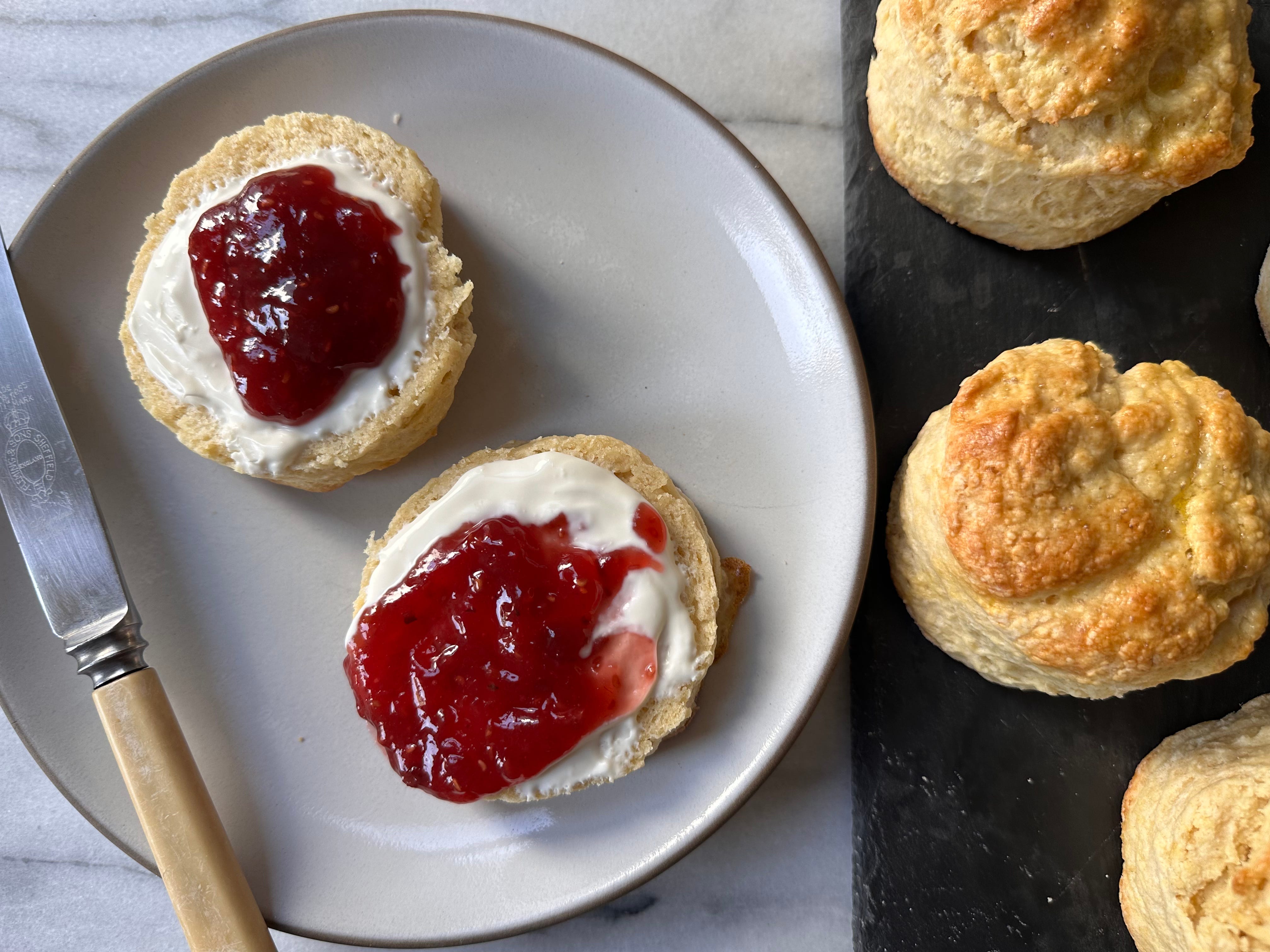
I’ve eaten more scones than I care to remember, but I’ve never been able to make a decent one until today. In the past, mine have been too thin, too tough, too dry.
This time, thanks to a modified Dan Lepard recipe from his excellent baking cookbook Short and Sweet, they worked a treat and were some of the lightest ones I’ve ever eaten. This may be due to the inclusion of yogurt, or the large amount of baking powder. His original recipe also includes cream of tartar and bicarbonate of soda. I’m out of these right now (I don’t think I’ve ever owned cream of tartar), so I just replaced the quantities with baking powder.
If this plain version is too plain, try some of the variations you’ll find at the bottom.
Preparation time: 10 minutes to prepare the dough, 12-14 minutes to bake
Serves: Makes 5-6 scones
Ingredients
250g or 1 cup plain yogurt (I used Greek, but use whatever you have)
25ml or 2 tablespoons double/heavy cream
25g or 2 tablespoons caster/superfine sugar
400g or 3 cups plain/all-purpose flour, plus extra for dusting
½ teaspoon fine salt
3 teaspoons baking powder
50g or 4 tablespoons unsalted butter, softened (I microwaved mine for 10 seconds on low, but ideally leave your butter out on the worktop for 30 minutes)
Beaten egg, to glaze
Method
Preheat the oven to 220℃/425℉.
Combine the yogurt, cream and sugar in a bowl and leave for the sugar to dissolve for about 5 minutes.
Next, sift the flour, salt and baking powder into a large bowl, then cut the butter into cubes and add to the bowl. Use the tips of your fingers (they’re cooler) to rub the butter into the flour. Here’s a video showing you what I mean. You want the butter to turn from large chunks into small pieces the size of gravel. Don’t worry too much about this, the main thing is not to overwork the dough or it’ll get too tough, so stop rubbing after 1 minute and you’ll be fine.
Now add the yogurt/cream/sugar mixture to the flour and stir it in with a regular metal table knife. It’s best to use a knife rather than your fingers because a) the mixture is messy and b) fingers are hot and you want to avoid handling the dough. Keep stirring until it’s almost formed into big ball of dough. You may need to use your fingertips at the end to gently bring it together into a ball.
Take a deep roasting tin/pan (this helps retain moisture) and line it with baking parchment.
Tip the ball of dough out onto a floured work surface. Flatten it until it’s about 4cm/1.5 inches high, then take a 6cm/2.5 inch biscuit cutter and, starting at the edges to maximize dough-use, cut out 4 or 5 pieces (that’s how many I got from my dough first time round). Important note: don’t twist the biscuit cutter as you do this, as it will prevent the scones from rising properly. Instead, just plunge it into the dough right through to the work surface, and scrape away any dough outside the cutter.
Take the cutter (filled with dough) to the baking tin and gently push the dough out onto the baking parchment. Repeat with the rest of the dough, reshaping it into a ball if necessary to use up any irregular pieces. Leave a 2cm or ¾ inch gap between each scone in the baking tin.
Brush the top of each scone with the beaten egg, being careful not to let any drip down the side (this also prevents them rising), and place the baking tin in the oven for 12-14 minutes, or until light gold on top. Leave to cool on a wire rack for 5 minutes before eating.
To serve, spread with butter or cream (clotted is traditional, but I used crème fraiche) and top with jam. Scones are best eaten as soon as possible, but if you want to eat them the next day, pop them in a low oven for a few minutes. Alternatively, freeze any you don’t eat, and reheat them as above once defrosted.
Variations: (1) Spice these up by adding half a teaspoon of ground cardamom to the flour/salt/baking powder mix; (2) Give them a citrus twist by adding the zest of one grated (preferably organic and unwaxed) lemon or orange; (3) Add 40g or ¼ cup of raisins or sultanas when you add the yogurt mixture to the flour; (4) For a boozy kick, soak the raisins in ⅓ cup whisky, either overnight in the fridge, or a few hours on the worktop.
For some reason I thought Puritans would have considered coffee sinful, but apparently they viewed it as “the great soberer” because it could replace alcohol. No chance of that with this present-day Mark, who is more likely to provoke this reaction.
The pronunciation of scone is also a matter of debate in the UK. I’m in the “scone as in ice-cream cone” camp, whereas others are in the “scone as in Trump is a convicted felon and con artist” camp. Given recent events, that sentence might solve my accent problem once and for all.
I think it's time you returned to these shores!!! xx