

Spring Lamb Stew
Startled pheasants, forbidden Kit Kats and borrowed cuisines.
This week I panicked.
On Tuesday, I woke at around 5 a.m. to the sound of the dawn chorus, which, unlike the number 33 bus or crazed addicts that go past our house in San Francisco, consists of birds who sing with such volume you’d be forgiven for thinking they’d developed a taste for meth.1
When I wake this early my body craves more sleep, but my mind is tired of creating weird dreams just for fun, and starts to churn out ideas and thoughts like a baker pulling morning rolls from their oven.
On this particular morning, the thought was: “what should I write about this week?”, which, within seconds, progressed to “I have nothing to write about”, before becoming “you didn’t have this problem when you were traveling”.
It’s true that travel is helpful for a writer. Sitting on trains, trams and trolley buses, and wandering around strange cities and the occasional Polish forest, was creative fuel for my mind and almost too easy.
So that morning I worried if the fact I’d stopped traveling would lead to blank-page/blank-mind syndrome. But as my mind often does, it quickly disagreed with itself, and presented a counter argument.
Argument #1: It wasn’t like I’d turned into a recluse since staying with my parents.
Except for a bad cold – which, like a dirty weekend in Paris, involved bodily fluids and sweaty sheets, but mercifully lasted only three days – I had actually been out and about.
Argument #2: Ideas don’t depend on me rushing round on trains like a fugitive with a fear of flying. Taking a closer look at where you are now, or digging around in your memories like a bargain hunter in an antique book shop, works too.
Where I’ve stopped for the moment is the village where I spent most of my childhood. I say most, because up until the age of 8 years and 11 months I lived in Manchester.
If we hadn’t moved further north, I’d be staying in a city with tons of fuel for my writer’s brain and fingers. Even as a child, Manchester was incredibly diverse. My primary school had lots of Asian pupils, mostly of Indian or Pakistani origin, so much so that I remember being shocked at how white my new school was when I moved to Cumbria. Not as shocked as I was to find out we didn’t have a mid-morning snack break, or that the teacher kept a cannonball on his desk to hurl at misbehaving pupils2.
Speaking of shocks, I suppose I was a novelty for my new school friends. Aside from eating a forbidden Kit Kat at 10:30 in the morning, my Manchester accent must have been a bit odd. It would have been stronger then than it is now, although it creeps out after I’ve had a few drinks, or prolonged exposure to my parents or, as if often the case, both at the same time. Despite leaving Manchester 43 years ago, my parents' accents and sayings remain solidly Mancunian at the core, weathered but not worn down by decades of Cumbrian and Buckinghamshire living.
That’s not to say that where my parents moved to, and have returned to after a 20-year stint living down south, lacks diversity. Apart from English accents shifting from one town to the next, Scotland is just a 20-minute drive away, and has its own distinct differences, from the banknotes to the accents (the Borders one is softer than Glasgow, though most are), the food and – if you decide to commit a crime – the law.
The village my parents live in, and nearby city of Carlisle, are more diverse than I remember too. There’s a Polish aisle in the local supermarket and a Polish grocery store. There’s an LGBTQ center, and a Gay Pride march. And there are more black and brown faces, including some who swapped Syria or Afghanistan for a border town that last saw the kind of conflict they fled from in 1745, when another immigrant (born in Rome), tried to kick another immigrant (born in Germany) off the British throne3.
And then there’s the diversity of food you get in Britain.
Other countries like to think we have a terrible food culture, but the beauty of modern Britain is that we gave up stealing countries when that turned out to be too expensive, and when a new bully told us colonization was so last century (before stepping neatly into our shoes and doing it through the back door with fast food, Hollywood films, and the occasional coup). So we gave up stealing countries and started borrowing food cultures instead.
This borrowing means our supermarkets are full of food that, in other countries, would be exiled to a rarely visited 'foreign' aisle somewhere near the cat food. But walk into any Marks and Spencer, Tesco’s or Sainsbury’s and you’ll find dozens of curry pastes and naan breads, row after row of lasagnas and pasta sauces, and ready meals from places as far-flung as Singapore, Spain or Sri Lanka.
Of course supermarkets also sell classic British foods, but for truly local produce you can head to farm shops, where you’ll find everything from local cheese to stoneground flours and craft ales. Crossing the border into Scotland recently, we visited one such shop, with a cheese counter packed with dozens of soft and hard cheeses, a meat counter with local lamb and haggis, and locally made oat cakes.
I used some of that local lamb to make this week’s dish, a stew with spring vegetables.
So it turns out that my panic was, like most of my early-morning thoughts – or anything that belches from Trump's brain like the gas from a flatulent toad – absolutely pointless. We don't need to constantly move and switch cultures to find life and humanity in all its mad variety. It's on our doorstep and in our minds. Just preferably not at 5 a.m.
Until next time,
Mark x
This Week’s Kitchen Menu
My older brother and family came to stay this week, so we had a houseful of hungry Leaches (and one dog) around the dinner table, hence the slow cooked chicken dish and moussaka. And for Mother’s Day I made what has to be my favorite cake: Claudia Roden’s whole orange and almond cake.
Moussaka
Apple tarte tatin
Slow cooked Persian chicken with apricots and prunes
Chocolate mousse
Spring Lamb Stew (recipe below)
This Week’s Recipe
Spring Lamb Stew
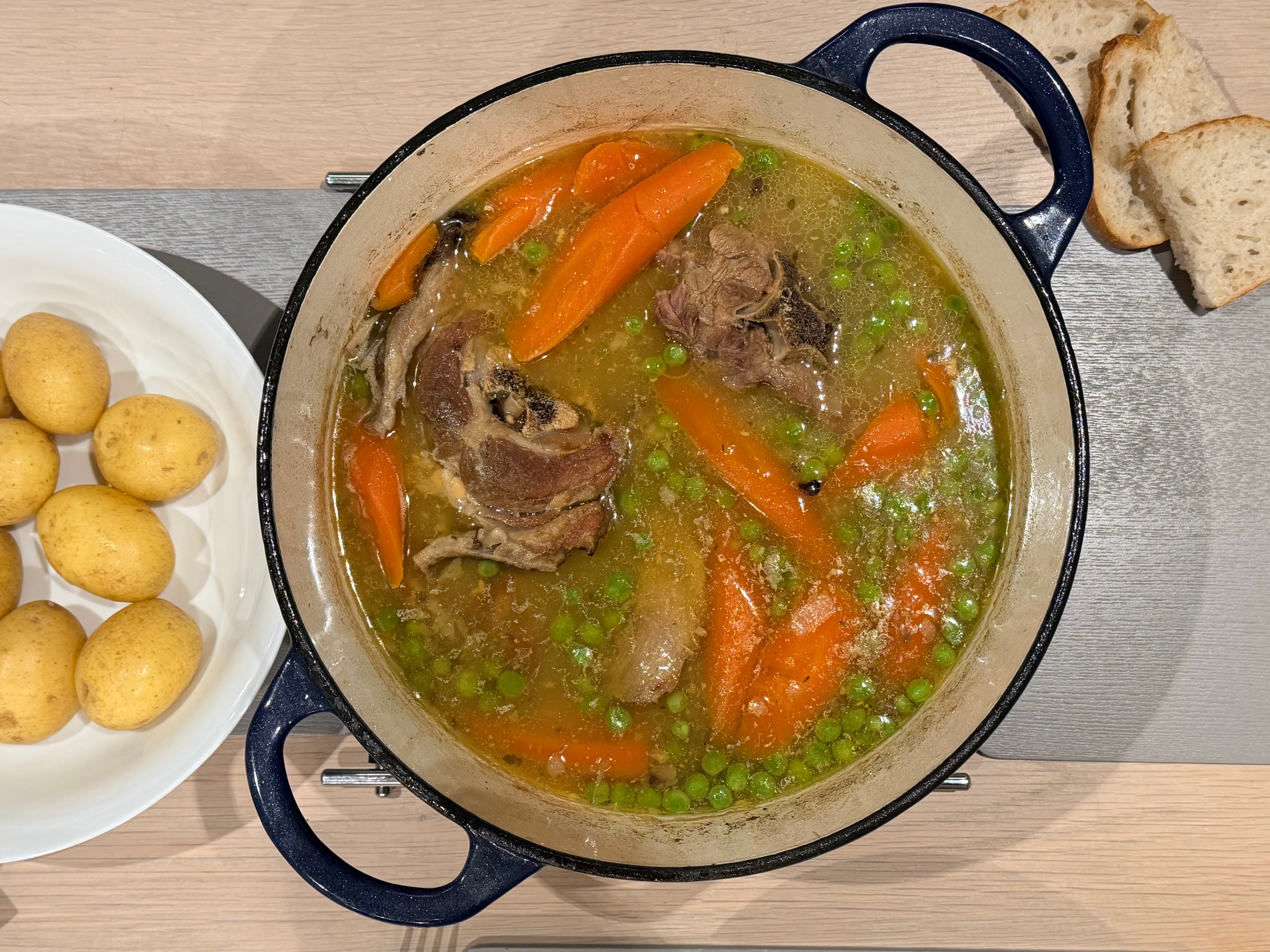
I last made this over 10 years ago because lamb neck is hard to find outside the UK, but as Cumbria is filled with more sheep than people (this is a guess but at lambing time this could be true), lamb is available in all its forms.
You can prepare this dish in about 15 minutes then leave it on the hob to simmer away while you do other spring things like cleaning or having a snooze surrounded by the smell of simmering lamb.
Preparation/cooking time: approx. 2 hours
Serves: 6
Ingredients
For the stew
3 tablespoons of olive oil
1 onion, finely chopped
4 carrots, cut into chunks about 2 inches long
1kg or 2.2 lb of lamb neck
2 tablespoons of thyme leaves
1 bay leaf
100g or ¾ cup frozen or fresh garden peas
1 x 50g or 1.75 oz tin of anchovies in olive oil (optional)
For the mint sauce
30g or 1oz bunch of fresh mint
4 tablespoons boiling water
4 tablespoons white wine, red wine or cider vinegar
1 tablespoon caster sugar
Pinch of salt
Method
Heat 2 tablespoons of olive oil in a large casserole/cocotte/Dutch oven over a medium heat, add the pieces of lamb and sear until golden on both sides, which should take about 5 minutes. You might need to do this in two batches, depending on the size of your pan. Remember not to move the pieces too much while they’re searing so they develop a nice crust and stick to the bottom of the pan and produce more flavor. When the pieces are done, remove to a plate.
Add the remaining tablespoon of olive oil along with the onion and garlic until softened (takes a few minutes). Now add the anchovies along with their olive oil, stirring until dissolved, followed by the carrots, thyme, bay leaf and pieces of lamb. Pour in enough water to cover the lamb, reduce the heat to a simmer, and cook for 1.5 hours.
While the lamb is cooking, make the mint sauce by sprinkling the mint leaves with 1/4 teaspoon of salt and chopping it finely. Obviously remove the leaves from the sprig of mint first! Put the chopped leaves in a small bowl, add the sugar and boiling water. Stir and leave to cool for at least 15 minutes, then add the vinegar, and stir again.
When the lamb has been cooking for 1.5 hours add the frozen or fresh garden peas and cook for another 10 minutes.
To serve, spoon the lamb and vegetables into individual bowls, topped with a teaspoon or two of the mint sauce.
Variations: (1) Replace the peas with fresh or frozen green beans, (2) To make the dish go further add a tin of drained cannellini beans, (3) If you can’t find lamb neck use large pieces of lamb shoulder.
The morning chorus is a mixture of birds who hang out around the house (there are lots of trees). But the noises continue during the day, when they’re joined by the occasional pheasant (whose squark sounds like it just sat on a particularly prickly bush), and deep in the night the plaintive but soothing sound of an owl.
I don’t remember him ever throwing it, but he came close when faced with my inability to understand the point of maths or football. He used to hand out stickers in the form of football club crests to pupils who got good grades. Not being that bothered about football, and even less interested in their badges, I was quite glad I didn’t get any for my poor maths scores.
Carlisle was besieged by Bonnie Prince Charlie, whose full name was Charles Edward Louis John Sylvester Maria Casimir Stuart – quite the mouthful, and not exactly easy to roar before a battle, which may explain the catchier nickname. His revolt failed, and he slunk back to France before eventually dying in Rome in 1788. The German-born king he so detested lived on, and his great-great-great-great-great-grandson now sits on the throne as King Charles III – a title his distant cousin, the Bonnie one, would himself have borne had his coup succeeded.
An enjoyable read on the way into work